Ranking System
Major Chinese-language Xiangqi apps, including Tiantian Xiangqi (天天象棋) and JJ Xiangqi, use broadly similar named ranks instead of presenting strength only as a Western-style rating. These apps account for a large share of online Xiangqi, although no audited cross-platform data supports a precise percentage and the details vary by app.
This page explains the difference between rating points and rank titles, how ratings change after ranked games, and how the full rank ladder is organized.
Rating points and rank titles
- Rating
- The number that changes after each ranked game.
- Rank
- The title attached to a rating range. Crossing a threshold changes the title.
How ratings change
Lixiangqi uses a simple zero-sum calculation for ranked games:
- Same rank: the winner gains 10 points and the loser loses 10.
- Adjacent ranks, lower-ranked player wins: +15 / −15.
- Adjacent ranks, higher-ranked player wins: +5 / −5.
- Draw: no rating change.
Ranked matchmaking permits players in the same or an adjacent rank. The rating floor is −250. Ratings can rise above 7000, but 专3-3 remains the highest title.
The rank ladder
Tiantian Xiangqi divides its ranks into three broad groups, and Lixiangqi uses the same set of rank titles.
Minimum rating for each Lixiangqi rank title
- 学Student Rank学1-1 to 学3-3
Rank Rating 学1-1 -250 学1-2 -200 学1-3 -160 学2-1 -120 学2-2 -80 学2-3 -50 学3-1 -30 学3-2 -20 学3-3 -10 - 业Amateur Rank业1-1 to 业9-3
Rank Rating 业1-1 0 业1-2 10 业1-3 20 业2-1 30 业2-2 40 业2-3 60 业3-1 80 业3-2 100 业3-3 120 业4-1 150 业4-2 180 业4-3 210 业5-1 240 业5-2 290 业5-3 340 业6-1 400 业6-2 460 业6-3 530 业7-1 600 业7-2 680 业7-3 760 业8-1 850 业8-2 960 业8-3 1080 业9-1 1200 业9-2 1500 业9-3 1800 - 专Professional Rank专1-1 to 专3-3
Rank Rating 专1-1 2100 专1-2 2500 专1-3 3000 专2-1 3500 专2-2 4000 专2-3 4500 专3-1 5000 专3-2 6000 专3-3 7000
What do the ranks mean?
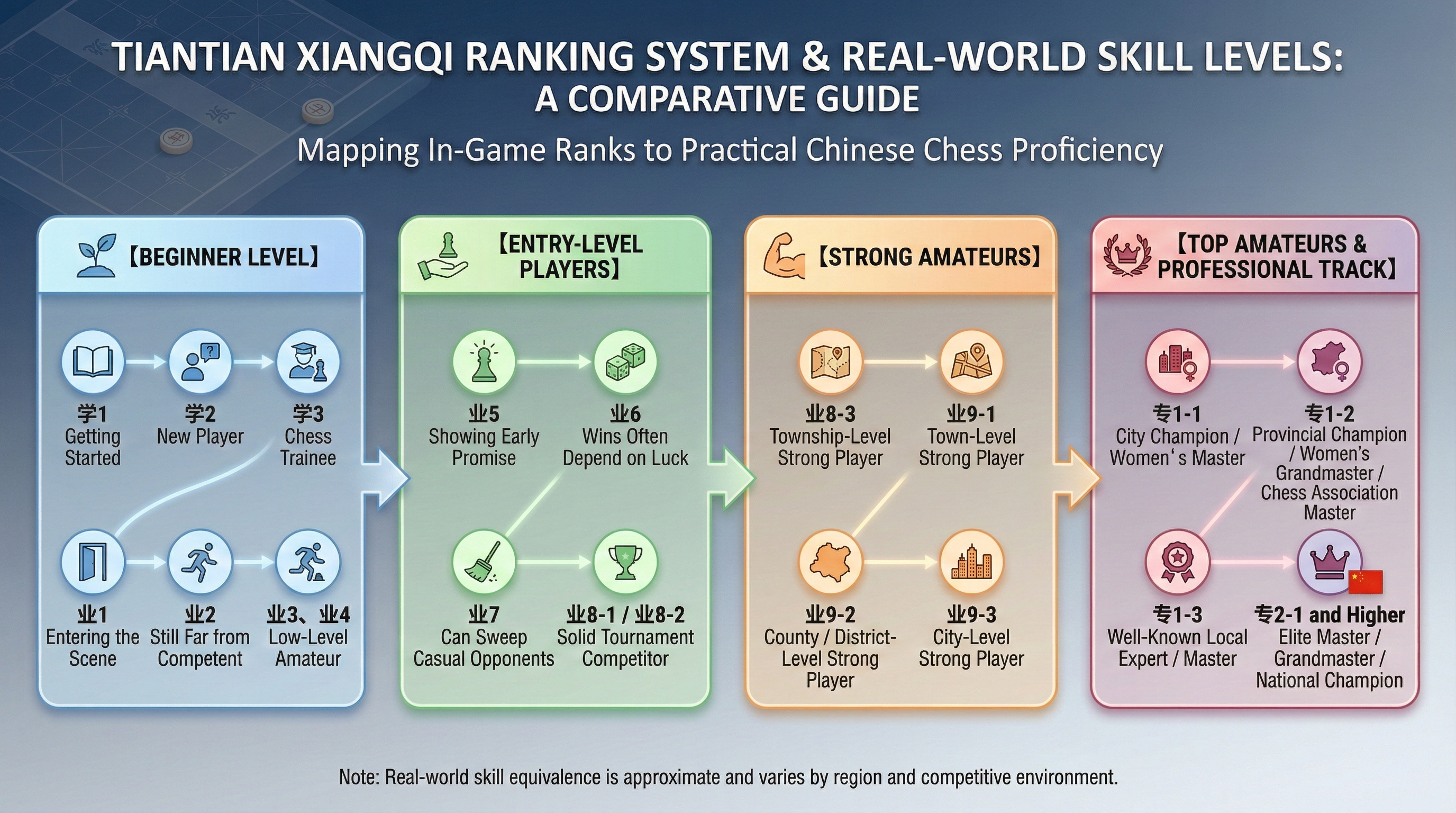
There is no formal real-world definition for these app ranks. In a May 2025 post, the official Tiantian Xiangqi account asked players on the Chess Player’s Home (棋友之家) forum whether a circulated rank-to-skill comparison was accurate. That question—and the varied replies—make the status clear: these are community interpretations, not official titles or qualifications.
The original Tiantian post and its replies discuss descriptions such as:
- 业1 — “Entering the Scene”
- 业7 — “Can Sweep Casual Opponents”
- 业8-1 / 业8-2 — “Solid Tournament Competitor”
- 专1-2 — “Provincial Champion / Women’s Grandmaster”
- 专2-1 — “Elite Master / Grandmaster / National Champion”
Some respondents considered the comparison broadly accurate; others placed the same ranks noticeably higher or lower. Region, competition strength, time control, and online play all affect the comparison.
How do Xiangqi ranks compare with Western Elo?
No direct formal conversion is possible. Elo measures results within a particular player pool; app ranks use their own pools, thresholds, matchmaking, and scoring rules. A number from one system is therefore not mathematically interchangeable with a number from the other.
One rough approach is to translate a rank into a description such as “solid tournament competitor,” then ask which Western chess rating might fit the same description relative to the neighboring levels. The video Tiantian Xiangqi Rankings Explained discusses that idea. It remains a theoretical, subjective, and unverifiable comparison—not a conversion table.