
Manchu+: one Banner against an army
A chariot, a cannon, and a horse in one piece. Meet the Qing-era game behind Manchu+, and the extra chariot that changes the contest.A chariot is pointing at one of your pieces. You put a soldier in the way. Against an ordinary chariot, that would stop the attack. Against the piece marked 旗, you have just supplied a cannon screen.
That is a good introduction to Manchu chess. Its most unusual piece, the Banner, can move and capture as a chariot, capture over a screen as a cannon, or make a horse move. Familiar defenses need another look. A piece that seems safely behind the front line may be the next one to disappear.
Manchu+ is now playable on LiXiangQi, against a friend, a computer opponent, or another player in its own rated pool. We use PyChess's adaptation, which gives the Banner some company: an ordinary chariot. To understand that small “+,” it helps to meet the older game first.
An army in one piece
In 1917, Shanghai's Commercial Press published Xu Ke's 徐珂 Qing bai lei chao (清稗類鈔), a vast collection of accounts of Qing life. Among its artists, doctors, and chess players is a short entry titled “Manchu chess.” The digitized first edition, preserved by National Taiwan University Library, preserves his description of the game.
One player has the usual sixteen pieces. The other keeps a general, two advisors, two elephants, and five soldiers. Beyond those, Xu writes:
餘僅一子,能兼車馬礮三用。
“Only one piece remains, able to serve as chariot, horse, and cannon.”
Eleven pieces face sixteen. The smaller army has traded away most of its attacking force for one piece with several ways to get at you. Xu warns that it can range through enemy territory and punish a careless defender beyond repair. His description already captures the attraction: you know where the dangerous piece is, but keeping it out is another matter. Read the Chinese entry.
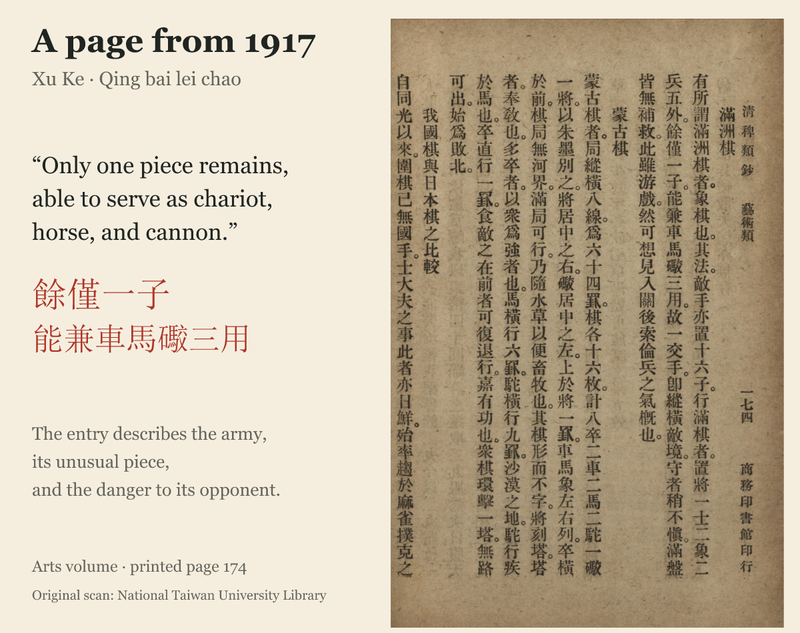
Xu Ke’s description of Manchu chess in 清稗類鈔 (1917), page 174. The entry occupies the rightmost text columns.
Xu ends by comparing the piece's freedom of action to the spirit of Solon soldiers after the Qing conquest. The name points to northeastern communities whose lives combined hunting, frontier trade, and service to the Qing; the Palace Museum's account of historian Lai Huimin's research describes how military recruitment could take men away from the forests and their sable harvests. Xu gives us a military image for the chess piece, but no inventor or date for the game's creation. His comparison is a glimpse of how he understood it, rather than a documented origin story.
The Banner connection has a wider setting. The Qing's Eight Banners organized communities as well as troops. The Palace Museum's Chinese account traces their development from hunting organizations into a system of military and civilian life, later including Manchu, Mongol, and Han Chinese banners. A “banner” meant much more than a flag carried into battle. It also placed people within an organized community.
The entry immediately before Manchu describes a three-sided xiangqi board with a branching river. He says its rules were no longer understood by the people shown it, and the set was eventually lost. These neighboring entries preserve two very different experiments with the same game—one adding an army, the other concentrating an army's powers into a single piece.
One name, several ways to play
You may encounter the names 满洲棋 (Mǎnzhōuqí), 满棋, or 一统棋 (Yìtǒngqí). Modern Chinese reference accounts collect these names, but the name alone does not settle the rules.
A 2012 article on the Chinese gaming site Ourgame, quoting Qing chao ye shi da guan (清朝野史大觀), describes three special pieces rather than Xu's one. A Chinese cultural account credited to Na Guoxue 那国学, republished in 2025, explicitly describes thirteen pieces and a general allowed to roam within its own half of the board. It also reports play in Manchu and mixed communities in Beijing, Tianjin, and northeastern China before the 1960s.
Those accounts show why “the traditional rules” needs qualification. They do not describe the same starting army as Xu, and they do not describe the game implemented here. LiXiangQi follows the single-Banner family of Manchu chess. Both generals stay in their palaces. You will not need to negotiate those details before an online game.
What the “+” adds
PyChess explains its change plainly: it found the original setup unbalanced and adapted it. In the older setup described on that page, Red has the Banner and no ordinary chariot; Black has a complete army. In Manchu+, Red has the complete army, while Black has the Banner and keeps an ordinary chariot. The Banner's movement itself has not gained another power.
This is the PyChess setup adopted by LiXiangQi, also identified as Manchu+R. Red starts with sixteen pieces. Black starts with twelve: the Banner, one chariot, a general, two advisors, two elephants, and five soldiers. Black has no horses or cannons. Red moves first.
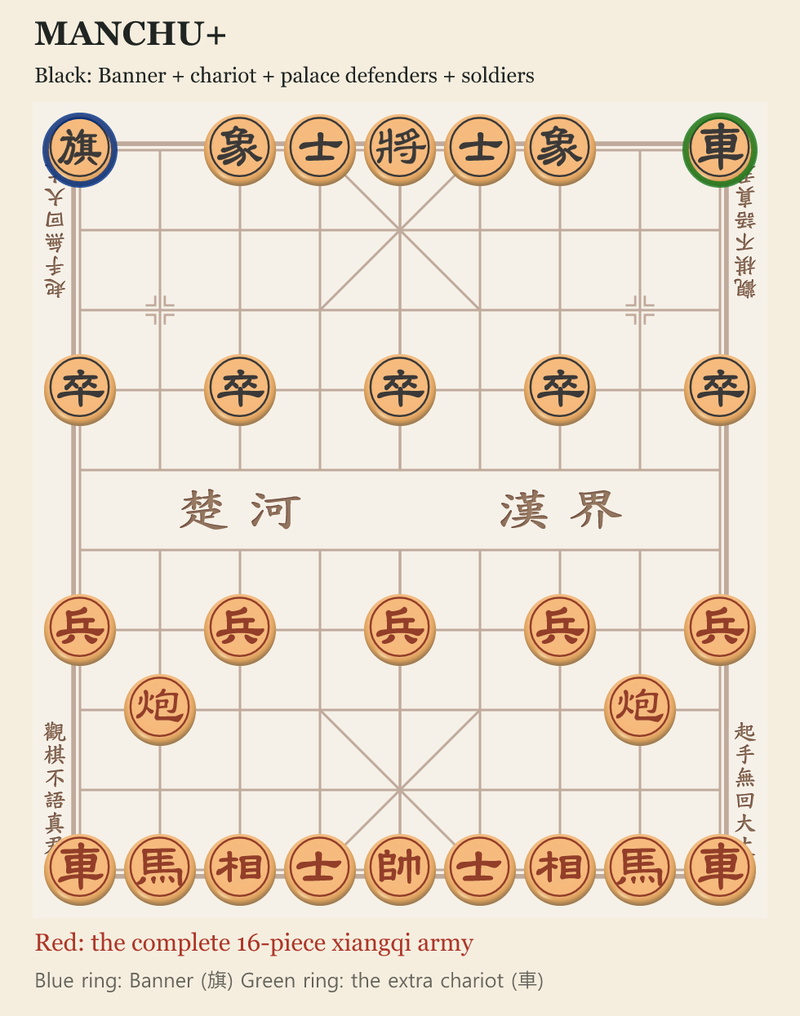
The starting armies on LiXiangQi. Seen from Red's side, the Banner is at the upper-left corner (a10); the extra chariot is at the upper-right (i10).
That extra chariot gives Black a second piece that can work across the board. While the Banner threatens one wing, the chariot can contest another file, defend the palace, or help finish an attack. Red can no longer organize every defensive move around one attacker.
The unequal armies remain the point. Red has more pieces to develop and coordinate. Black has fewer attackers, but the Banner can change how it attacks without spending a turn changing what it is. Capturing it does not automatically end the game, although losing so much strength in one capture is a serious matter.
The defender's uncomfortable discovery
A Banner chooses one kind of move each turn. It can slide along an unobstructed rank or file, capturing as a chariot does. It can capture an enemy piece beyond exactly one intervening piece, of either color, as a cannon does. It can also make the usual horse move, provided the horse's leg is clear. It cannot combine a slide and a horse move into a single turn, or slide diagonally like an international-chess bishop.
The first two powers work together particularly well. A chariot wants a clear line; a cannon wants a screen. The Banner can use either arrangement. Putting one piece between it and your general therefore does not, by itself, stop a straight-line check.
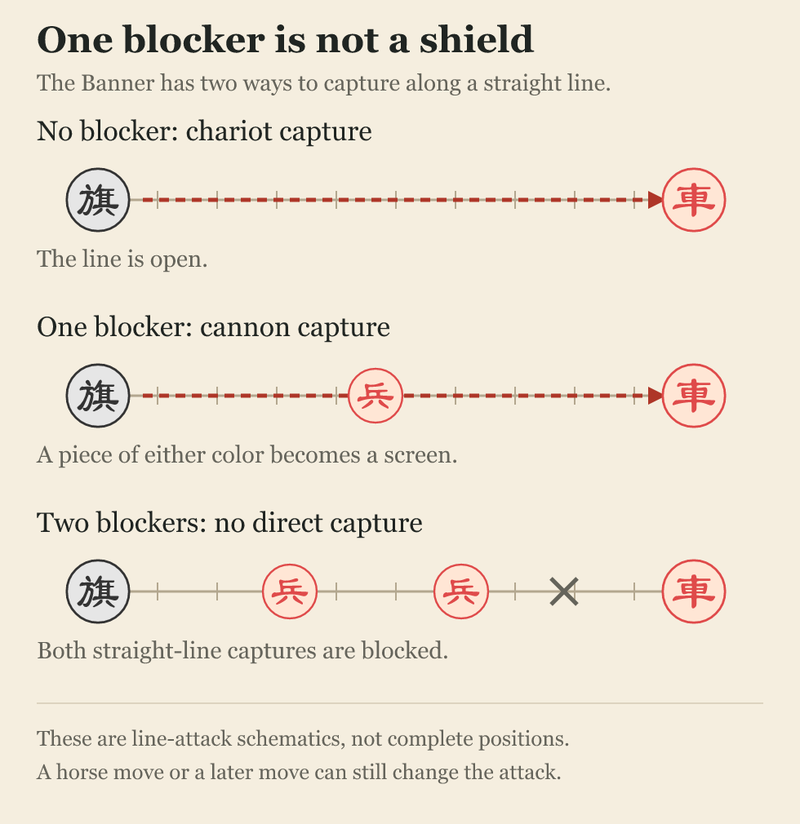
Count the pieces between the Banner and its target. Zero permits a chariot capture; one permits a cannon capture; two stop that direct line attack. These are schematics, not complete game positions.
Try the thought experiment in reverse. In the bottom example, move either soldier out of the line. The remaining soldier becomes a screen, and the red chariot is exposed. A move that seems to clear some harmless congestion can uncover an attack from a piece that has not moved at all.
There are limits. The Banner cannot make a non-capturing leap over a screen along a rank or file. Its horse move still has a leg that can be blocked by either color. And every move must leave its own general safe. A powerful piece pinned in front of its general cannot simply gallop away.
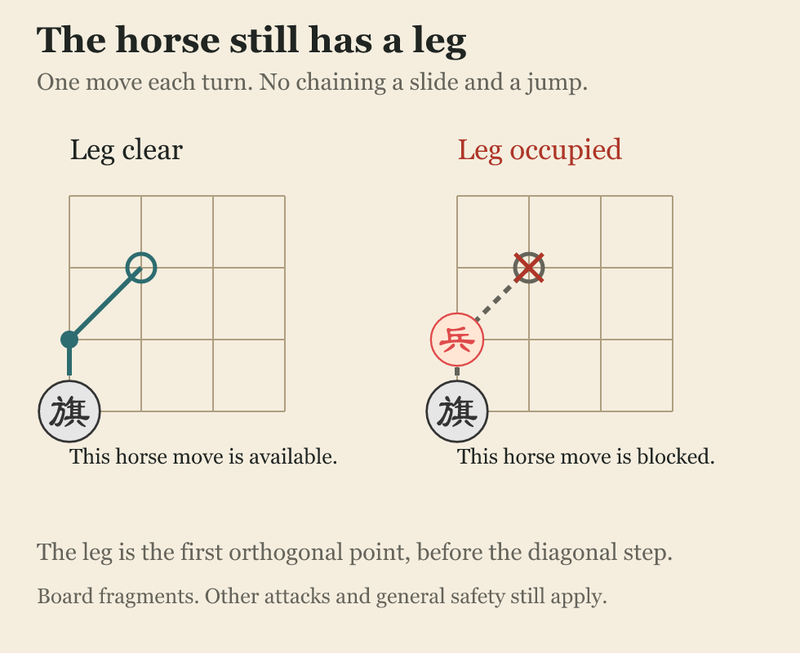
The Banner inherits the xiangqi horse's restriction. The marked destination is two points forward and one to the side; the intervening leg must be empty. Other attacks and general safety still have to be checked.
Playing the two sides
In this short LiXiangQi game against a computer, Black needed only three turns. The Banner crossed from a10 to b10, rushed down to b2, and slid across to g2. Red had moved both cannons and a soldier, leaving the Banner a route into the second rank.
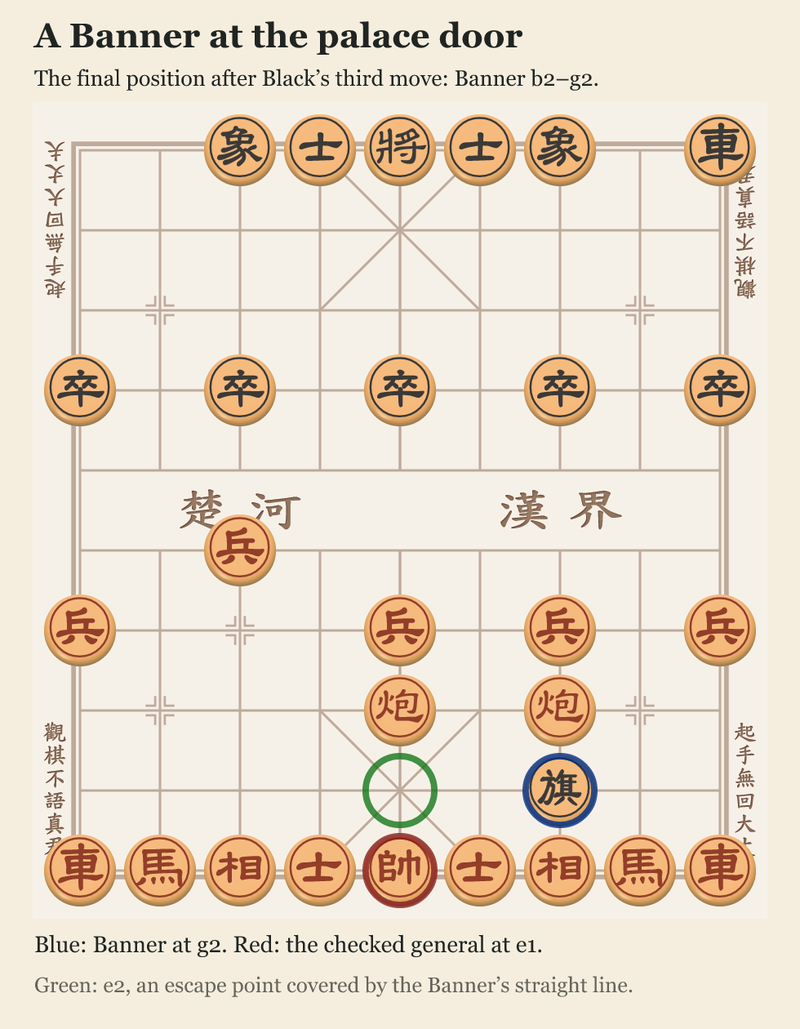
Final position from the linked game. The Banner at g2 checks the general at e1 as a horse, through the empty leg at f2. The green ring marks e2, which the Banner attacks as a chariot. The general's two advisors occupy its sideways exits.
Red cannot capture the Banner or block its horse leg in time. Moving the general forward walks into the Banner's straight-line attack. All sixteen red pieces are still on the board, yet the game is over. Xu's warning about a careless defender feels less distant here.
With Red, start by looking beyond the piece the Banner seems to attack. A soldier in front of a chariot may be helping the enemy. Before moving a blocker, count the intervening pieces again. When the Banner approaches your palace, check its horse attacks as well as its straight lines; a defense that works against one mode may leave the other open.
Red's extra pieces give you opportunities to make threats in more than one place. Develop them so they can support each other. Exchanging an active piece just to reduce the material on the board can help Black if it leaves the Banner with open routes and fewer defenders to face. Judge the position after the exchange, rather than assuming that the side with more pieces should trade everything.
With Black, the temptation is to spend every turn moving the Banner. The ordinary chariot deserves work too. If it can hold a file or tie down a defender, the Banner has less to do by itself. Look for moves that threaten through a screen in one direction and by a horse move in another. Your opponent must answer both possibilities, even though you will choose only one on the next turn.
A capture is not automatically a bargain. Before taking a soldier, imagine where the Banner will stand afterward and which red pieces can attack that point. Collecting a small piece is little consolation if your principal attacker gets trapped. The palace still needs attention while the Banner is away.
Bring the old experiment to the board
Choose Manchu+ on the LiXiangQi homepage to play the computer, invite a friend, or enter rated play. Manchu+ has its own rank progression. Its rated room gives each player ten minutes, with a sixty-second move limit and a thirty-second limit for each of the first three moves.
The Manchu+ analysis board supports the variant, using Fairy-Stockfish for local evaluation. After a game, return to a position where a piece disappeared unexpectedly. Try the defensive move you had intended, then count the screens and check the horse legs. Following the reply will teach you more than the evaluation number alone.
The familiar xiangqi restrictions remain: advisors stay in the palace, elephants stay on their side of the river, and the generals cannot face each other on an open file. Checkmate wins; stalemate is also a loss. On LiXiangQi, threefold repetition normally draws, but a player who alone gives perpetual check loses. Fifty moves by each player without a capture also draw; soldier moves do not restart that count. This variant has no separate Tiantian chasing adjudication. The Manchu+ rules page is the reference for play here.
For a first session, play two games and swap colors. One game lets you discover how much work a Banner can do. The other makes you sit across from it—and reconsider the soldier you were about to put in its way.
You may also like
 ChineseChessOutLoudOfficial LiXiangQi post
Singapore 2026: Phan Huy Hoàng leads the Open, Meng Fanrui wins rapid gold
Vietnam’s Phan Huy Hoàng won six games and drew one at the World Xiangqi Open. China still took the … ChineseChessOutLoudOfficial LiXiangQi post
Is janggi (Korean chess) coming to lixiangqi? Not anytime soon. Here's why.
Janggi looks familiar to a xiangqi player, but supporting it properly means taking its rules, presen… ChineseChessOutLoudOfficial LiXiangQi post