
Introducing Three Kingdoms on LiXiangQi
Play three-player xiangqi against two bots, with one friend and a bot, or with two friends. A captured general brings an entire army under new command.Three Kingdoms is now playable on LiXiangQi. Three players share a board, each with the usual sixteen xiangqi pieces. Capture another player's general and you take command of their remaining army. You can be doing quite well against one opponent, only to watch the third player take the general and collect all the pieces you were about to win.
You can play against two computer opponents, invite one friend and let a bot take the third seat, or play with two friends.
Finding three players
We used 三人象戏 (Sān Rén Xiàng Xì) as our reference for the modern game's behavior and rules. It is a WeChat mini-game and one of the most common online apps for this variant. Its gameplay videos and app listing show the three armies in action.
Every time I logged in to try it, I couldn't find a match. Getting three people ready at once is difficult when the game already has a small audience. I wanted to learn it, but I couldn't even get a game started.
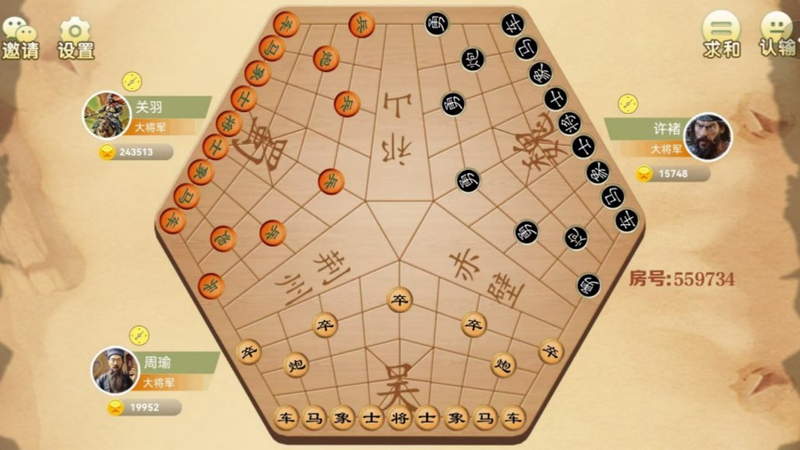
The three armies of 三人象戏 gathered around the hexagonal board. View the game gallery.
That experience made computer opponents a priority for LiXiangQi. The engine can take either or both of the vacant seats, so you can try the game whenever you have time. It runs in your browser, offers several difficulty levels, and handles army takeovers under the same rules as human players. There is plenty of work left to do on its playing strength. Even in this first version, though, it solves the problem that kept me from playing.
We wanted to bring the experience of 三人象戏 to an international audience. LiXiangQi provides a translated interface and a choice of piece sets, including international symbols for players who are still learning the Chinese characters. The bots give those players someone to practice against.
Saving an opponent's general
Suppose you are Red. Green's general is exposed, and Black can capture it on the next turn. You might have an attack of your own, but can you beat Black after Black acquires Green's chariots and cannons?
Sometimes your best move is to save Green.
There are no permanent teams. Green can still take your general a few moves later, and you may eventually regret helping. Even an equal exchange between two armies can leave the third player ahead. You have to consider who benefits from a fight, including the player who hasn't joined it.
The armies represent Wei, Shu, and Wu, whose wars and alliances give the game its Three Kingdoms name. The setting fits the play very well. It also predates the surviving descriptions of this board game by many centuries.
Three Kingdoms and Three Friends
Game of the Three Kingdoms, or 三國棋 (Sān Guó Qí), is the variant implemented here. Game of the Three Friends, or 三友棋 (Sān Yǒu Qí), is a separate three-player game with a different board and additional rules. LiXiangQi does not yet support Three Friends.
A Chinese account published by 联众 mentions Song-era works called 三国图格 and 三象戏图. Those texts have been lost, so their titles cannot tell us whether their games used the rules we know today.
For Three Kingdoms, an 1876 account by O. von Möllendorff gives us a recognizable board: three ordinary xiangqi half-boards joined into a hexagon, with a three-armed river between them. The Three Kingdoms historical overview gives the publication details.
Three Friends has a surviving manual of its own. The National Central Library's rare-book catalogue records a 1697 edition of Zheng Jinde's 郑晋德 三友棋谱, or “Manual of Three Friends Chess,” in the 昭代丛书 collection. Its board includes mountains, cities, and an ocean. Flag and fire pieces have special movement rules, described in the Three Friends overview.
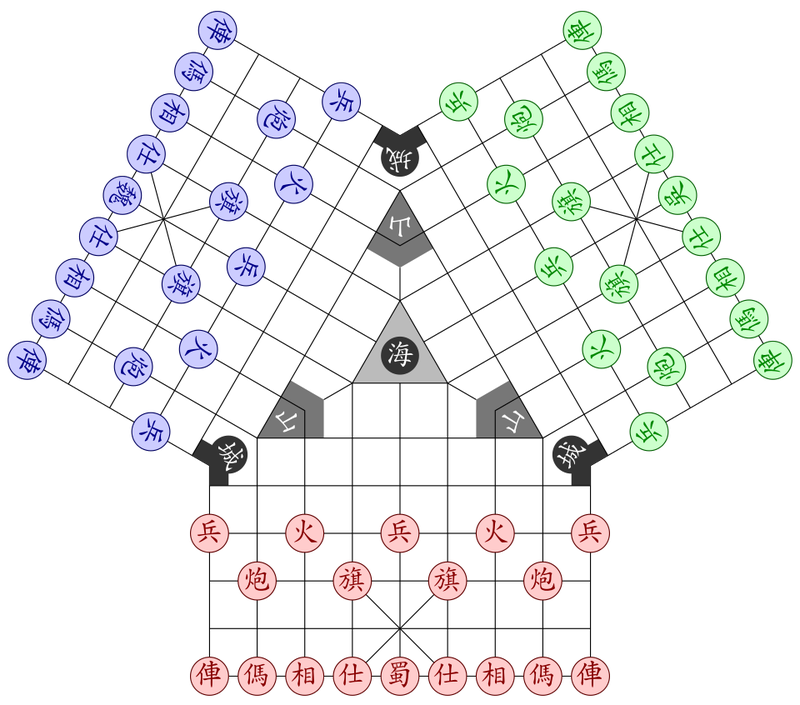
Game of the Three Friends (三友棋), which has not been implemented on LiXiangQi. Diagram by Mliu92, via Wikimedia Commons, CC BY-SA 4.0, reproduced without alteration.

In the “象棋” entry of 两般秋雨盦随笔, Liang Shaoren 梁绍壬 describes this game of flags, fire, and terrain, and refers readers to the 昭代丛书 manual. He also describes the danger of allowing one army to swallow another:
夫救彼正所以固我也。
“Saving him is precisely how I protect myself.”
Liang’s advice also applies when Black threatens to capture Green’s general. The boards differ, but both games can put you in the uncomfortable position of needing an opponent to survive.
Different Three Kingdoms rules
Even within Three Kingdoms, sets and rulebooks differ. Before playing, check the piece count and what happens when someone loses a general.
Sixteen pieces or eighteen?
The usual board has three home territories around a shared river. Some sets use sharply bent lines; others curve the routes to make the connections easier to follow. Chariots follow those connected routes, including the bends.
Some versions add two bannermen to each army. The Three Kingdoms rules overview describes optional flag, fire, and wind pieces for the respective kingdoms. These have different rules from the flag and fire pieces in Three Friends. LiXiangQi uses sixteen pieces per player, without bannermen.
The wooden set below has eighteen per side. Look between each pair of cannons: the two extra pieces are visible there.
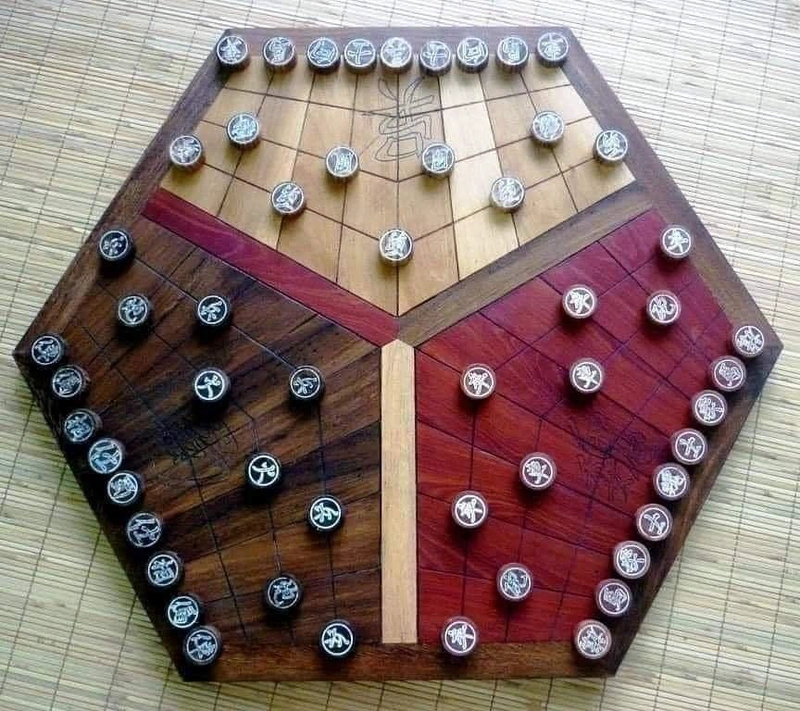
A wooden set with two extra pieces per army. Photo shared by ND Minh Đức in this Tinh Tế discussion, May 2020.
Removing an army or taking it over
Zhang Laiyou's 张来友 1986 patent application, published in 1987, describes forty-eight pieces on a “six-cornered fish-tail” board. It explains that a bent line has the same movement meaning as a straight line in ordinary xiangqi, and that check does not interrupt the turn order. A defeated army is removed from the board.
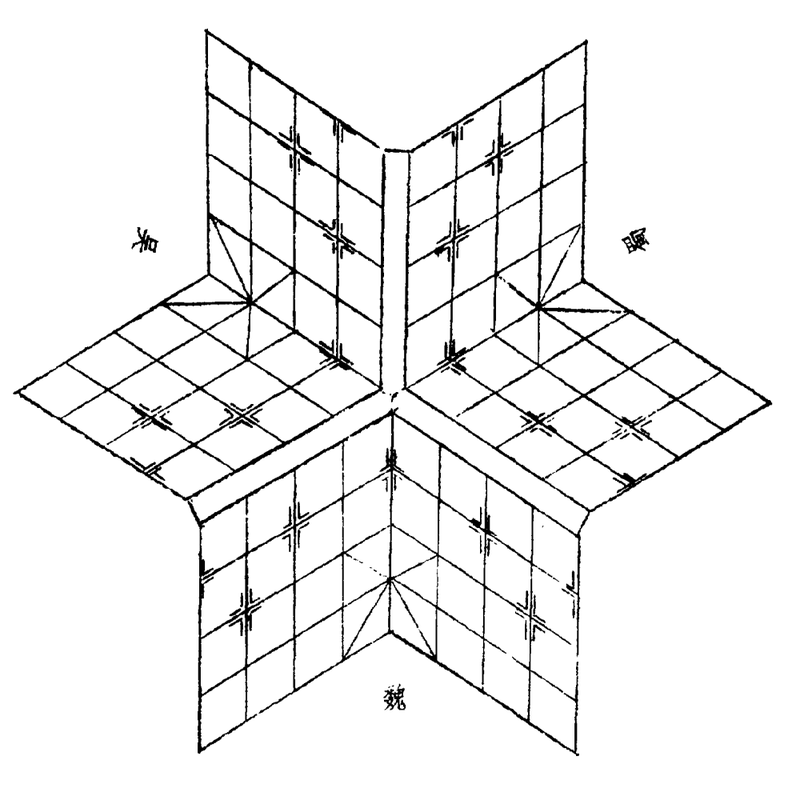
The board drawing from Chinese patent publication CN86209844U, page 6 (1987).
A 1992 application by Pan Yongcheng 潘永成, published in 1993, describes both 撤子法, removing the defeated pieces, and 收编法, taking command of them. Under the first rule, a victory clears an army off the board. Under the second, the winner acquires that army and becomes much more dangerous to the remaining player.
Descriptions also differ on when elimination takes place. Some published Three Kingdoms rules begin with checkmate and allow a separate turn to remove the general and take over its army. On LiXiangQi, with three players still active, an exposed general can survive until someone captures it. The army changes hands immediately upon capture.
Playing on LiXiangQi
Our Three Kingdoms rules page specifies the rules used here, including resignations, timeouts, and positions where two opponents are giving check. Historical descriptions and the reference app do not necessarily resolve every case in the same way.
Shu is red, Wu is green, and Wei is black. Each begins with sixteen pieces. Play proceeds Shu → Wu → Wei, starting with Shu. Check never changes this order.
Chariots follow connected ranks and files. Cannons need exactly one screen to capture. Horse legs and elephant eyes can be blocked, just as in ordinary xiangqi. Elephants stay in their original territory, and advisors stay in their original palace. Soldiers gain sideways movement after crossing the river, but cannot return home or enter the third territory. There are no promotions.
When you capture an active general, you receive every army that player controlled. The pieces retain their colors and movement restrictions. If Red acquires Green's army, Green's soldiers still move in their original direction. Red can choose from either army on subsequent turns, but receives no extra turn for the capture.
You must keep your general safe whenever a safe move exists. There is one exception to the usual result of checkmate: while all three players are active, a checked player with no safe response can make another mechanically valid move. That player remains in the game until the general is captured or another loss condition applies. The intervening third player might still change the position. Once only two players remain, ordinary general safety applies, and checkmate or stalemate ends the duel.
A player who resigns or runs out of time while in check normally gives their army to the checking player. An unchecked withdrawal removes the army. See the rules page for simultaneous checkers, inactive “fallen generals,” and repetition.
Try a game
Start with two computer opponents, or invite a friend and fill the remaining seat with either another friend or a bot. Both modes are casual. Rated play has a separate Three Kingdoms rank and uses fifteen minutes per player, with a sixty-second limit on each move.
You can explore positions on the analysis board, review completed games, or spectate. For a first game, I would start with the computer and spend a few moves following the chariot routes across the river. Then keep an eye on whose turn comes next. You don't want to do all the work of breaking into a palace just to give someone else an army.
You may also like
 ChineseChessOutLoudOfficial LiXiangQi post
Surprise YouTube guest ShakenCannon ties for first at LiXiangQi
DanielCallabieto and ShakenCannon each won three straight games to share the Friendly Tournament Are… ChineseChessOutLoudOfficial LiXiangQi post
Is janggi (Korean chess) coming to lixiangqi? Not anytime soon. Here's why.
Janggi looks familiar to a xiangqi player, but supporting it properly means taking its rules, presen… ChineseChessOutLoudOfficial LiXiangQi post