
Introducing Jieqi on LiXiangQi
Most of your army starts face down. Learn how reveals and hidden captures work, then try Jieqi against a friend or PikaJieQi.Jieqi begins with a problem you don't have in ordinary xiangqi: most of your army is face down. The piece on a chariot's starting point moves like a chariot on its first turn. It might then reveal itself as a soldier, leaving you to make use of a rather different piece wherever you've put it.
The game is called 揭棋, or Jieqi, often translated as Reveal Chess. It's now playable on LiXiangQi. You can challenge another player or try a computer opponent, and there is an analysis board for studying the positions afterwards.
Moving a piece before you know what it is
Jieqi uses the ordinary xiangqi board and all 32 pieces. Each general starts face up in its usual place. Each player shuffles their other fifteen pieces, face down, onto the remaining starting points. Your pieces belong to you throughout; only their identities are concealed.
On its first move, a concealed piece moves as the piece that normally starts on that point. From a soldier point, it moves one step forward. From a horse point, it makes a horse move, subject to the blocked-leg rule. From a cannon point, it can jump a screen to capture.
The piece turns over after moving. All its later moves follow its revealed identity. You can't look underneath before choosing the first move, and revealing it doesn't take another turn. Tencent's Chinese rules show how this works.
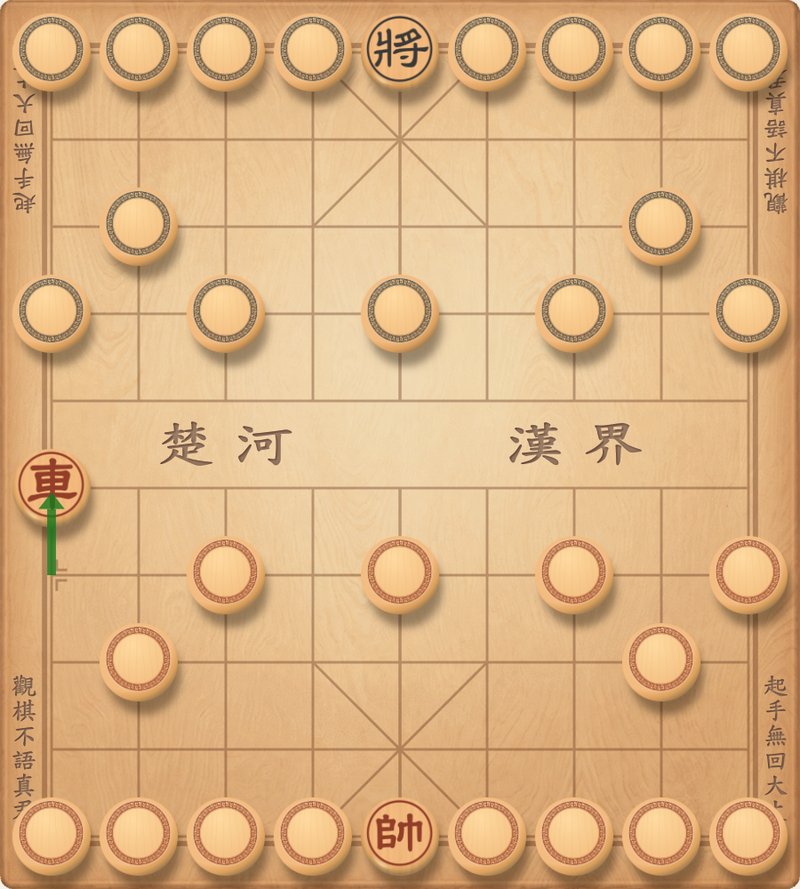
The leftmost red soldier point has advanced one step and revealed a chariot. On its next turn, that piece will move as a chariot. A concealed piece can reveal any of the identities still available in its army.
Revealed advisors can leave the palace, and revealed elephants can cross the river. They keep their movement shapes: one point diagonally for an advisor, two for an elephant. The elephant's eye can still be blocked. An elephant revealed near the enemy palace may therefore help attack it.
The remaining movement rules are familiar. Generals stay in their palaces and cannot face each other on an open file. Horses have legs; cannons need a screen to capture. A revealed soldier's ability to move sideways depends on which side of the river it occupies. Checkmate wins, and a player with no legal move also loses.
Hong Kong, Guangdong and cờ úp
Published accounts place Jieqi's development around Hong Kong, Guangdong and Macau, but disagree about its date and inventor. The Chinese-language overview records several of those accounts.
A 2011 interview with Hong Kong master Chiu Yu Kuen (赵汝权), preserved on PTT, describes the first Zhongyi Cup in Hong Kong on May 1 of that year and a second event in Huizhou that September. Established xiangqi players were taking part in organized Jieqi competition by then.
In 2015, Chiu defended the final stage of a challenge competition at Guangzhou Cultural Park, with Lü Qin presenting prizes. Yangcheng Evening News journalist Ge Wanli reported on the event. The 2017 Guangdong Open regulations list nine rounds, fifteen minutes per player and a 10,000-yuan first prize.
In Vietnam, the closely related game is called cờ úp. Players often use little covers to hide the pieces. A visitor from the World Games Museum described seeing covered sets around Ho Chi Minh City in 2017.
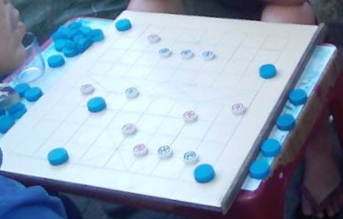
A cờ úp game with blue covers over the unrevealed pieces. Photo: Gokimines, Wikimedia Commons, CC BY-SA 4.0, unmodified.

You may also hear Jieqi called “dark chess.” That name can cause confusion with Banqi, which uses half a xiangqi board and different movement and capture rules. Hong Kong's Deaf Welfare Promotion Association introduces the two games separately in its Chinese account of a community teaching session. On a Jieqi board, both generals are visible from the start.
Deciding what to reveal
A chariot revealed in an active position can rescue an attack. An advisor revealed on the same point may leave you with very little to do there. You have to allow for both before making the move.
There is also a reason to leave some pieces concealed. A piece on a chariot point can still travel along a clear rank or file. Moving it uses up that opportunity if it turns out to be another type. Likewise, a piece on a cannon point may be able to make a useful capture over a screen. Revealing it early could cost you that capture later.
You can keep track of the possibilities. Each side begins with five concealed soldiers and two of every other non-general type. The first reveal has a one-in-three chance of being a soldier and a two-in-fifteen chance of being a chariot. After both chariots have appeared, there is no reason to choose a move that depends on finding a third.
The uncertain outcomes don't make calculation optional. You still need to check whether a revealed piece will be attacked, whether your general is safe, and what the opponent can do with the pieces already visible. Before committing to a move that needs a chariot, work out what you would do if the piece became a soldier.
Captures on LiXiangQi
If a piece is captured before being revealed, neither player sees its identity during the game. Only in a completed-game review can viewers see what those captured pieces were.
Suppose one of your concealed pieces has been captured and you have found only one chariot. You cannot cross the second chariot off your list. It may have been captured, or it may still be on the board. The missing piece leaves you with incomplete information about the survivors too.
Some apps let the capturing player look at the captured piece. A 2019 Chinese xiangqi industry white paper discusses the disagreement over that convention. LiXiangQi keeps it hidden from both sides.
LiXiangQi prohibits continuing the same checking piece's sequence beyond six checks, or a qualifying chase of the same target beyond six turns. Forty moves by each side without a capture produce a draw; revealing a piece doesn't reset the count. The fifth occurrence of the same position with the same player to move also draws. The site keeps those counts during play.
Playing against PikaJieQi
The computer opponents and browser analysis use PikaJieQi, through the Pikafish-derived build maintained by Brian H. Liou.
The bot receives the visible position and the inventory of possible identities. It doesn't receive the secret arrangement. Captured unrevealed pieces remain unknown to it, just as they do to the players.
When its search reaches a reveal, the engine considers the possible identities and weights them by the remaining counts. Five possible soldiers get more weight than two possible chariots. Search limits and adjustments for dangerous outcomes also affect the score, so it should be read as an evaluation of the position under uncertainty. It isn't a prediction of which piece will turn over.
An unlucky reveal can spoil a reasonable move. When reviewing a loss, try going back to the information you had before the piece turned over. If the move worked only when a chariot appeared, perhaps you gambled unnecessarily. If several likely reveals left you with a good game, the decision may have been sound.
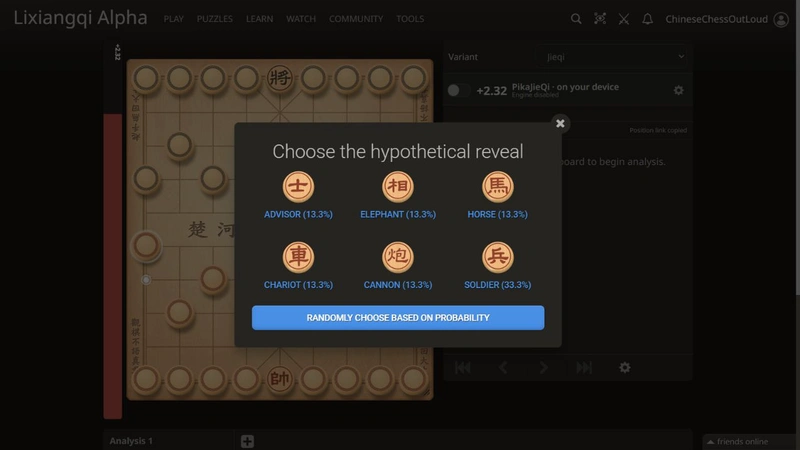
The analysis board lets you select an identity for a hypothetical reveal, or sample one using the displayed probabilities. During a live game, players cannot choose their reveals.
You can try this on the Jieqi analysis board. Make a move with a concealed piece, choose a hypothetical identity and follow the continuation. Then return to the same move and try another identity. The evaluation runs on your device, and both Chinese and international notation are available.
Completed-game review gives you information you didn't have while playing. Use it to understand what happened, but judge your earlier choices with the hidden pieces still hidden.
Start a game
Choose Jieqi / Reveal Chess on the homepage to play the computer, challenge a friend or enter rated play. Jieqi has its own rating and rank progression, separate from standard xiangqi.
For the first game, give yourself enough time to inspect the board after each reveal. The move you planned for your cannon may no longer exist, while a newly revealed elephant may suddenly have a route across the river.
You may also like
 ChineseChessOutLoudOfficial LiXiangQi post
Is janggi (Korean chess) coming to lixiangqi? Not anytime soon. Here's why.
Janggi looks familiar to a xiangqi player, but supporting it properly means taking its rules, presen… ChineseChessOutLoudOfficial LiXiangQi post
Surprise YouTube guest ShakenCannon ties for first at LiXiangQi
DanielCallabieto and ShakenCannon each won three straight games to share the Friendly Tournament Are… ChineseChessOutLoudOfficial LiXiangQi post