
Introducing Mini Xiangqi on LiXiangQi
Twelve pieces per side on a 7×7 board, with soldiers that can move sideways immediately. Mini Xiangqi is now playable on LiXiangQi.Take the advisors and elephants out of a xiangqi set and you are left with twelve pieces per side. Mini Xiangqi puts them on a 7×7 board, removes the river and lets the soldiers move sideways immediately. The general still has a palace, but defending it takes some adjustment without its usual guards.
Mini Xiangqi is now playable on LiXiangQi, with computer opponents and a separate rated pool. The analysis board also supports it. If you are learning xiangqi, you can practice the horse's blocked leg and the cannon's screen with fewer piece types to remember. Experienced players will have to work out some new openings.
A 1973 design from Osaka
PyChess and Mats Winther credit Mini Xiangqi to Shigenobu Kusumoto of Osaka, Japan, in 1973. Winther's references include David Pritchard's Classified Encyclopedia of Chess Variants and a 1999 issue of Eteroscacco, the Italian chess-variant journal.
Organized xiangqi was also developing in Japan at that time. The Japan Xiangqi Association dates its predecessor to 1973, when shogi master Yasuharu Ōyama supported an organization for promoting and studying the game. The first All-Japan Championship followed in 1974. The association publishes its history in Japanese, and the Asian Xiangqi Federation has a Chinese account.
You can now play Mini Xiangqi through software such as Fairy-Stockfish, or make a board and use the pieces from a regular set.
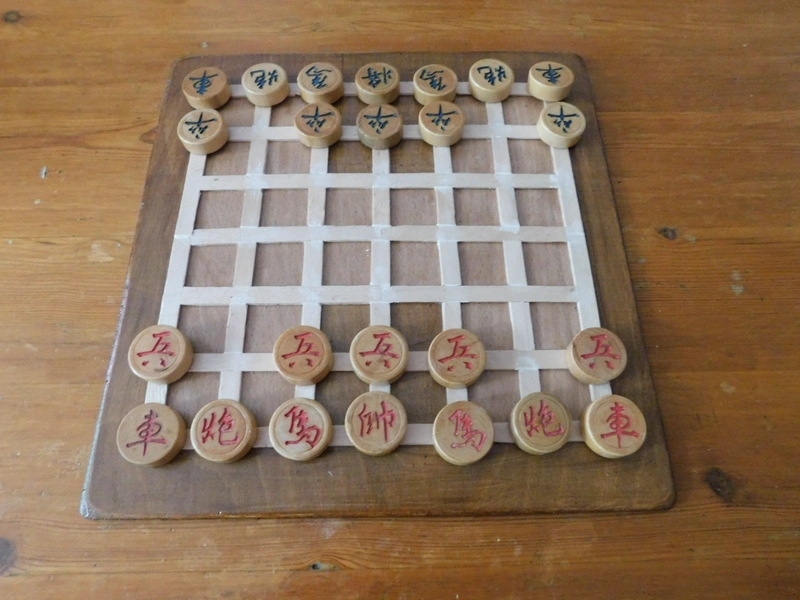
A handmade set from Chess Creations & Collection, December 2022. The board uses plywood and wooden craft sticks; the pieces come from a regular xiangqi set.
The photograph shows the entire starting arrangement. Each army has seven pieces across its back rank and five soldiers immediately in front. There are no special pieces to buy.
The board and pieces
Mini Xiangqi has 49 intersections, compared with 90 in standard xiangqi. Pieces sit on the intersections. Each end has a three-by-three palace, and there is no river.
The back rank, from left to right, is chariot, cannon, horse, general, horse, cannon, chariot. The five soldiers stand on the first, third, fourth, fifth and seventh files of the next rank.
Soldiers can move one point forward or sideways from the first turn. They never move backward, and they do not promote on reaching the far edge. With no advisors or elephants, that accounts for the changes to the ordinary piece set.
Chariots move along clear ranks and files. A horse makes its usual move unless a piece blocks its leg. A cannon moves along a clear line and captures by jumping exactly one piece, of either color. The general moves one point horizontally or vertically inside its palace; the palace diagonals don't let it move diagonally.
Red moves first. You must answer check and cannot leave your general attacked. The two generals cannot face each other on an open file. Checkmate wins, and stalemate is also a loss for the player who cannot move.
What the soldiers can do
In the starting position, the leftmost red soldier can step inward. That opens the file for the chariot behind it while keeping the soldier close to home. In ordinary xiangqi, that soldier would have to cross the river before it could step sideways.
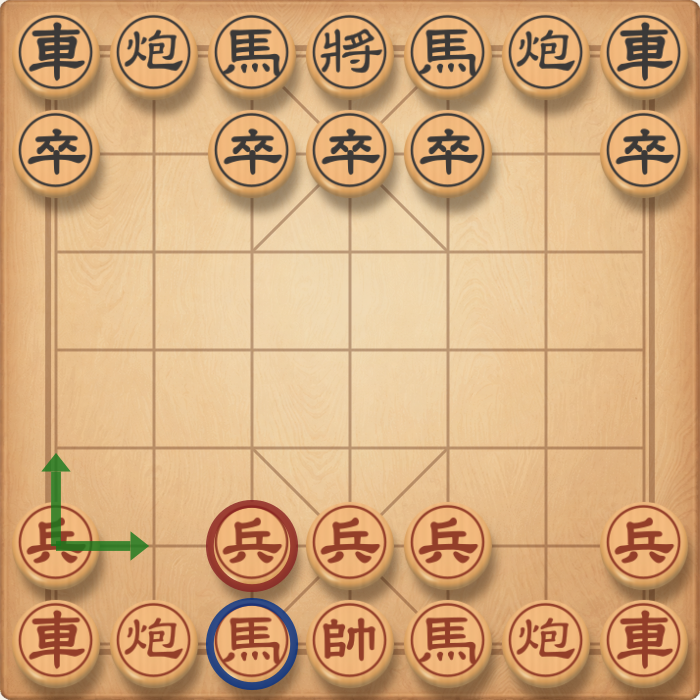
The arrows show the leftmost soldier's forward and sideways moves. The horse circled in blue cannot move through the soldier circled in red: its forward leg is blocked.
The soldiers in front of the horses also affect development. Moving one can free the horse's leg. If you come from international chess, check the intervening point before assuming that a horse can reach an empty destination. A friendly piece blocks its leg just as effectively as an enemy one.
A soldier in a cannon's line can be useful. The cannon needs a screen to capture, so clearing a file can remove an attack. The same soldier might be obstructing a chariot. Before moving it, look at both pieces.
Those decisions transfer to standard xiangqi. You will encounter different opening formations there, but you will still need to clear horse legs, arrange cannon screens and open files for chariots.
A palace without guards
An ordinary xiangqi general can shelter behind its advisors and elephants. Here, a soldier or a major piece may have to defend the palace instead. Keeping a chariot back for defense costs you its use elsewhere, and a soldier that advances cannot step back to repair the position.
Exchanges deserve some care. Trading an attacking piece may leave the material count even while removing your general's only defender. Look at the remaining checks before agreeing to the trade.
In an endgame, your own general can help restrict the enemy general through the facing-generals rule. An open file may deny the opponent an escape square and allow a chariot or soldier to finish the attack. This is also a good place to remember that stalemate wins. You can win by taking away every legal move even when the last move isn't check.
The rules on LiXiangQi
Winther describes optional soldier promotion and another arrangement with leopard pieces. LiXiangQi uses the regular twelve-piece-per-side game: no promotion, no leopards, and sideways-moving soldiers from the start.
The piece movement follows Fairy-Stockfish's Mini Xiangqi implementation. LiXiangQi adjudicates repetition on the third occurrence of the same position with the same player to move. The usual result is a draw. If only one player gave check on every one of their turns in the repeating cycle, that player loses for perpetual check. This ruleset has no separate chasing adjudication.
Fifty moves by each side without a capture also draw. Soldier moves don't restart the count. Anyone used to international chess's fifty-move rule will need to account for that difference.
Computer games and analysis
Choose Mini Xiangqi on the homepage to challenge a friend, play a computer opponent or enter rated play. Its rating and rank progression are separate from standard xiangqi and Jieqi.
The computer opponent and analysis board use Fairy-Stockfish with its Mini Xiangqi rules and classical evaluation. The WebAssembly project supplies the browser engine.
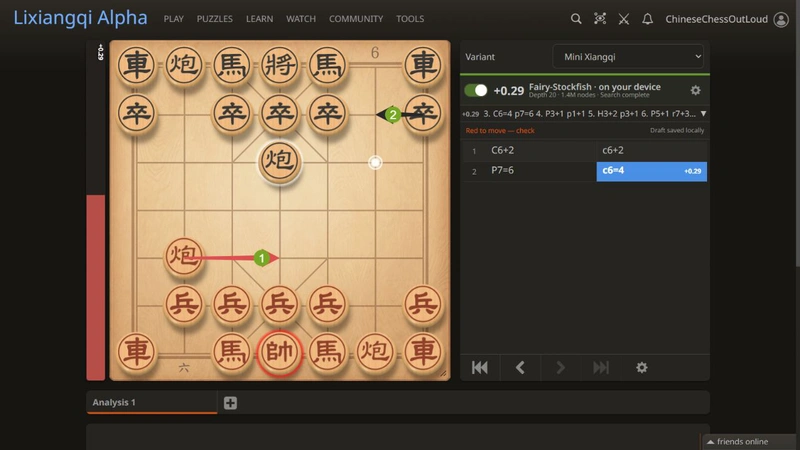
Fairy-Stockfish analyzing a Mini Xiangqi position on LiXiangQi. The evaluation runs on the viewer's device.
On the analysis board, you can play through a line and return to an earlier position to try an alternative. Chinese and international notation are available, along with the site's board themes and piece sets.
For a first session, try developing a horse and finding a route for a chariot. Watch how the soldiers affect both plans. If you finish a game unsure about an exchange or a palace defense, bring that position into analysis and play it again.
You may also like
 ChineseChessOutLoudOfficial LiXiangQi post
Singapore 2026: Phan Huy Hoàng leads the Open, Meng Fanrui wins rapid gold
Vietnam’s Phan Huy Hoàng won six games and drew one at the World Xiangqi Open. China still took the … ChineseChessOutLoudOfficial LiXiangQi post
Surprise YouTube guest ShakenCannon ties for first at LiXiangQi
DanielCallabieto and ShakenCannon each won three straight games to share the Friendly Tournament Are… ChineseChessOutLoudOfficial LiXiangQi post